Thursday, February 28, 2008


Wednesday, February 27, 2008
The Gospel of Jeremic
February 27, 2008
Op-Ed Contributor
One Nation, Indivisible
By VUK JEREMIC
Belgrade, Serbia
THE international system that has brought unprecedented prosperity to the world since 1945 is based on rules that apply without exception. This system is supposed to protect the basic, legitimate national interests of every country, whether rich or poor, strong or weak. Its binding principles include the sovereign equality of states, the respect for the territorial integrity and the inviolability of internationally recognized borders.
Yet on Feb. 17, the Serbian province of Kosovo, which has been under United Nations administration since 1999, unilaterally declared independence from my country. This illegal act has, unfortunately, been recognized by the Bush administration and some European countries including Britain, France and Germany. Others in Europe — including Greece, Romania and Spain — have withheld recognition, as have most other leading global and regional players, including Brazil, China, Egypt, India, Israel, Russia and South Africa.
As things stand, the number of countries that will recognize an independent Kosovo will plateau at around 40, leaving it unrecognized by a vast majority of the close to 200 members of the United Nations. This includes, of course, the Republic of Serbia.
A peaceful demonstration of close to half a million people in Belgrade last week condemned this act of illegal secession. Unfortunately, a few hundred hooligans attacked several embassies, including that of the United States, and looted stores; they even attacked my ministry. Our government has condemned these acts, and will prosecute the offenders.
The case against recognition is based not only on the Security Council’s 1999 resolution reaffirming Serbia’s sovereignty over Kosovo, but also founded on the view that the international system has, as a result of this hostile act by the Kosovo Albanians, become more unstable, more insecure and more unpredictable.
Here’s why. Recognizing the unilateral declaration of Kosovo’s independence from Serbia legitimizes the doctrine of imposing solutions to ethnic conflicts. It legitimizes the act of unilateral secession by a provincial or other non-state actor. It transforms the right to self-determination into an avowed right to independence. It legitimizes the forced partition of internationally recognized, sovereign states.
It violates the commitment to the peaceful and consensual resolution of disputes in Europe. It supplies any ethnic or religious group that has a grievance against its capital with a playbook on how to achieve its ends. It even resurrects the discredited cold-war doctrine of limited sovereignty.
A historical injustice is being imposed on a European country that has overcome more obstacles since we democratically overthrew Slobodan Milosevic in October 2000 than most other nations have in a much longer time. Recognizing Kosovo means saying, in effect, that Serbian democracy must be punished because a tyrant — one who committed heinous deeds against the Kosovo Albanians in the 1990s — was left unpunished. Such misplaced revenge may make some feel better, but it will make the international system feel much worse.
To act out of a false moral imperative to right a supposed historical wrong will contribute neither to international security nor to the region’s prospects of European Union membership. It is time to take a step back and examine the damage done.
If we can find a creative way to step back from the abyss that is Kosovo’s unilateral declaration of independence, we could not only salvage the credibility of the international system, but even strengthen it through a re-commitment to its basic principles. Some will say that it’s too late to put the genie back in the bottle. I don’t believe that’s true, because it’s never too late to forge a prosperous future for all stakeholders to share.
What is absolutely certain is that trust needs to be rebuilt and values must be reaffirmed. The way forward lies in coming together and securing an agreement between the two parties: a negotiated, compromise solution to Kosovo’s future status that addresses the legitimate right to broad self-governance for Kosovo’s Albanians, while preserving a democratic Serbia that is whole and free, integrated into Europe, and engaged with a world set aright through prudent statecraft.
The legitimacy of the international system hangs in the balance.
Vuk Jeremic is the foreign minister of Serbia.
Op-Ed Contributor
One Nation, Indivisible
By VUK JEREMIC
Belgrade, Serbia
THE international system that has brought unprecedented prosperity to the world since 1945 is based on rules that apply without exception. This system is supposed to protect the basic, legitimate national interests of every country, whether rich or poor, strong or weak. Its binding principles include the sovereign equality of states, the respect for the territorial integrity and the inviolability of internationally recognized borders.
Yet on Feb. 17, the Serbian province of Kosovo, which has been under United Nations administration since 1999, unilaterally declared independence from my country. This illegal act has, unfortunately, been recognized by the Bush administration and some European countries including Britain, France and Germany. Others in Europe — including Greece, Romania and Spain — have withheld recognition, as have most other leading global and regional players, including Brazil, China, Egypt, India, Israel, Russia and South Africa.
As things stand, the number of countries that will recognize an independent Kosovo will plateau at around 40, leaving it unrecognized by a vast majority of the close to 200 members of the United Nations. This includes, of course, the Republic of Serbia.
A peaceful demonstration of close to half a million people in Belgrade last week condemned this act of illegal secession. Unfortunately, a few hundred hooligans attacked several embassies, including that of the United States, and looted stores; they even attacked my ministry. Our government has condemned these acts, and will prosecute the offenders.
The case against recognition is based not only on the Security Council’s 1999 resolution reaffirming Serbia’s sovereignty over Kosovo, but also founded on the view that the international system has, as a result of this hostile act by the Kosovo Albanians, become more unstable, more insecure and more unpredictable.
Here’s why. Recognizing the unilateral declaration of Kosovo’s independence from Serbia legitimizes the doctrine of imposing solutions to ethnic conflicts. It legitimizes the act of unilateral secession by a provincial or other non-state actor. It transforms the right to self-determination into an avowed right to independence. It legitimizes the forced partition of internationally recognized, sovereign states.
It violates the commitment to the peaceful and consensual resolution of disputes in Europe. It supplies any ethnic or religious group that has a grievance against its capital with a playbook on how to achieve its ends. It even resurrects the discredited cold-war doctrine of limited sovereignty.
A historical injustice is being imposed on a European country that has overcome more obstacles since we democratically overthrew Slobodan Milosevic in October 2000 than most other nations have in a much longer time. Recognizing Kosovo means saying, in effect, that Serbian democracy must be punished because a tyrant — one who committed heinous deeds against the Kosovo Albanians in the 1990s — was left unpunished. Such misplaced revenge may make some feel better, but it will make the international system feel much worse.
To act out of a false moral imperative to right a supposed historical wrong will contribute neither to international security nor to the region’s prospects of European Union membership. It is time to take a step back and examine the damage done.
If we can find a creative way to step back from the abyss that is Kosovo’s unilateral declaration of independence, we could not only salvage the credibility of the international system, but even strengthen it through a re-commitment to its basic principles. Some will say that it’s too late to put the genie back in the bottle. I don’t believe that’s true, because it’s never too late to forge a prosperous future for all stakeholders to share.
What is absolutely certain is that trust needs to be rebuilt and values must be reaffirmed. The way forward lies in coming together and securing an agreement between the two parties: a negotiated, compromise solution to Kosovo’s future status that addresses the legitimate right to broad self-governance for Kosovo’s Albanians, while preserving a democratic Serbia that is whole and free, integrated into Europe, and engaged with a world set aright through prudent statecraft.
The legitimacy of the international system hangs in the balance.
Vuk Jeremic is the foreign minister of Serbia.
Thursday, February 21, 2008
Hey Ma, can you hear me? We are news again ... so is our distant cousin!!!

So, fires have become the protest weapon of choice for the "thugs" of Serbia. Are these really "thugs" or just a convenient labeling by both sides to understate the frustration of a large population in Serbia? Personally, I have no problem with people who want to vent their frustration ... nobody likes to give away power or their view of power willingly. So I sent out some emails to some people (non-US and non-Euro) and here are some advices they have for the protesting "thugs":
1. Wearing hoodies is not the chic fashion for true protesters. Otherwise it might be interpreted that you are not really sure of what you are protesting for and are more afraid for your jobs and getting arrested than for your cause. Did Che, Chavez or Mandela wear hoodies? Answer is NO!!!
2. While fires might be cute on tv news, they have this nasty habit of being uncontrollable atimes, as evidenced by the dead person from the US embassy fire. Perhaps try more modern technology.
3. Going back home in Belgrade for dinner and sleep after breaking open borders just seems plain lazy and shows lack of commitment. Here is a quote from a gal on a small island: "I am not in the military and even I will tell you that it's more effective to occupy any territory taken. Heading home for the night and then coming back to retake the same border is a waste of effort and has the potential to make you seem like the "boys" who cried wolf. For heaven's sake, occupy Kosovo already if you are so intent on taking it back."
.... and lose the cell phones on camera. Makes you look more like a drug dealer rather than a soldier for the heartland.
There you have it folks. From moi, here are a couple of news links that are interesting to read:
- Storming of embassy in Serbia sparks U.S. outrage (apparently, Kostunica apologized to the US but no one has apologised yet to the dead body found in the fire - martyr or moron?)
Stories ... Kosova
Taking a little break from the Independence euphoria, I started searching for stories and articles that might have been written about non-independence-related Kosovo matters (like the one below); considering there were tons of journalists here ... one or 2 might have been interested in other parts of life in Kosovo. It was a futile search. If you know of any, please send to me. As a bonus, I found this: Articles written when Kosovo was not famous...
It's 'Islam lite' as Kosovars shun extremist Muslim dogma
Faith in Islam can coexist with a fondness for a beer at the local in the country seen as Europe's bulwark against radicalisation
By William Kole
in Gnjilane, Kosovo
KASTRIOT Sadiku, 25, has a confession: like a good Muslim, he was near a mosque when Kosovo declared independence. But like a good Kosovar, he was just around the corner from it, sipping beer at his favourite pub. "In the entire Muslim world, I think that's probably something that can only happen here, where our religion doesn't interfere with the rest of our lives," he said.Much has been made of Kosovo's status as the world's newest mostly Muslim nation. But its secular government, religious leaders and faithful have carefully distanced themselves from the slightest hint of extremism.The fledgling Republic of Kosovo, they insist, embraces a decidedly laid-back version of Islam."Our Islam is 'lite' – like Coke Lite or Marlboro Light cigarettes," said Ilmi Krasniqi, an imam at one of five mosques in the eastern town of Gnjilane. "This is not Baghdad, and what goes on in Saudi Arabia cannot happen here."Agim Hyseni, the chief imam in Gnjilane, said Muslims in feverishly pro-United States Kosovo have distanced themselves from extremist ideology or acts. "The people here feel no empathy for those kind of acts," he said. "They know very well what terrorism is because they've suffered through so many terrorist acts."But if terrorism is a relative term in Kosovo, so is "Muslim".The Ottoman Turks imported Islam centuries ago, but it has npt saturated this society. Kosovo was Christian before, about 7 per cent of its ethnic Albanians are Catholics, and a large cathedral is being built in the heart of Pristina, the capital.The late president Ibrahim Rugova was fascinated with Roman Catholicism, and there were even unconfirmed reports after his death in 2006 that he had converted.Although the conflict pitted Albanian Muslims against Christian Orthodox Serbs, who consider Kosovo the cradle of their religion and national identity, it was a battle for turf – not a holy war."We've never had a Christian-Muslim conflict here," said Albulena Hoti, 20, strolling in Gnjilane beneath the flags of the United States, Britain and Germany – all among the first countries to recognise Kosovo after it declared independence on Sunday.Stephen Schwartz, the executive director of the Centre for Islamic Pluralism, a Washington-based think tank, contends that Kosovo will become a model of religious pluralism in Europe. "lbanian Islam is moderate, and constitutes a bulwark against radicalisation of European Muslims," he said."I don't think there's any other Muslim country in the world where there's so much Christian missionary activity that goes on undisturbed." Kosovo's conflict drew only a smattering of mujahideen – Islamic fighters from the Arab world – unlike the 1992-5 Bosnian war, where they came by the thousands to aid their Muslim brothers.Outside Gnjilane's main mosque, the crowd of young men included some with long, wiry beards. But they are quick to eschew the strict Wahhabi interpretation of Islam followed by al-Qaeda leader, Osama bin Laden."I'm proud that our democratic and recognised country is first and foremost a very tolerant and secular state," said Fikret Morina, a 31-year-old Muslim tradesman. "The world has no reason to be afraid of us."
It's 'Islam lite' as Kosovars shun extremist Muslim dogma
Faith in Islam can coexist with a fondness for a beer at the local in the country seen as Europe's bulwark against radicalisation
By William Kole
in Gnjilane, Kosovo
KASTRIOT Sadiku, 25, has a confession: like a good Muslim, he was near a mosque when Kosovo declared independence. But like a good Kosovar, he was just around the corner from it, sipping beer at his favourite pub. "In the entire Muslim world, I think that's probably something that can only happen here, where our religion doesn't interfere with the rest of our lives," he said.Much has been made of Kosovo's status as the world's newest mostly Muslim nation. But its secular government, religious leaders and faithful have carefully distanced themselves from the slightest hint of extremism.The fledgling Republic of Kosovo, they insist, embraces a decidedly laid-back version of Islam."Our Islam is 'lite' – like Coke Lite or Marlboro Light cigarettes," said Ilmi Krasniqi, an imam at one of five mosques in the eastern town of Gnjilane. "This is not Baghdad, and what goes on in Saudi Arabia cannot happen here."Agim Hyseni, the chief imam in Gnjilane, said Muslims in feverishly pro-United States Kosovo have distanced themselves from extremist ideology or acts. "The people here feel no empathy for those kind of acts," he said. "They know very well what terrorism is because they've suffered through so many terrorist acts."But if terrorism is a relative term in Kosovo, so is "Muslim".The Ottoman Turks imported Islam centuries ago, but it has npt saturated this society. Kosovo was Christian before, about 7 per cent of its ethnic Albanians are Catholics, and a large cathedral is being built in the heart of Pristina, the capital.The late president Ibrahim Rugova was fascinated with Roman Catholicism, and there were even unconfirmed reports after his death in 2006 that he had converted.Although the conflict pitted Albanian Muslims against Christian Orthodox Serbs, who consider Kosovo the cradle of their religion and national identity, it was a battle for turf – not a holy war."We've never had a Christian-Muslim conflict here," said Albulena Hoti, 20, strolling in Gnjilane beneath the flags of the United States, Britain and Germany – all among the first countries to recognise Kosovo after it declared independence on Sunday.Stephen Schwartz, the executive director of the Centre for Islamic Pluralism, a Washington-based think tank, contends that Kosovo will become a model of religious pluralism in Europe. "lbanian Islam is moderate, and constitutes a bulwark against radicalisation of European Muslims," he said."I don't think there's any other Muslim country in the world where there's so much Christian missionary activity that goes on undisturbed." Kosovo's conflict drew only a smattering of mujahideen – Islamic fighters from the Arab world – unlike the 1992-5 Bosnian war, where they came by the thousands to aid their Muslim brothers.Outside Gnjilane's main mosque, the crowd of young men included some with long, wiry beards. But they are quick to eschew the strict Wahhabi interpretation of Islam followed by al-Qaeda leader, Osama bin Laden."I'm proud that our democratic and recognised country is first and foremost a very tolerant and secular state," said Fikret Morina, a 31-year-old Muslim tradesman. "The world has no reason to be afraid of us."
Wednesday, February 20, 2008
UNESCO Heritage Site???
... or perhaps UNICEF heritage site. Or no need at all if a dash is added in between to read: "Free-Kosova". One thing for sure, this wall was a darling for photo-journalism in Kosovo.


Tuesday, February 19, 2008

Sunday, February 17, 2008
REPUBLIC OF KOSOVA!!!
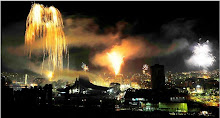
... told ya ... and the party is on.... please, be careful with the "happy shooting". (pics below were culled from the net; mine will come later)


I-DAY is Here!!!
Less than 2 hours away from the eventual announcement. I wish I could feed you a live video feed but I am not that tech savy ... It's a regional party and apparently, everyone is invited. Nice to know that Kosovars are actually immune to cold temperatures. I always suspected this but witnessed it several times last night with people in t-shirts when I thought the cold would break off my c***. I have tons of pics and will upload them for y'all after the celebrations. No politics talk today. I just want to be happy for a people who seem happy.
Congrats KOSOVA!!!
Congrats KOSOVA!!!
Friday, February 15, 2008
Independence is in the air ....
... and the ladies of Prishtina still look as hot as ever :)
In case you are not aware, we all expect some sort of proclamation of independence this weekend. Many are betting on Sunday 17 Feb (night). I have my money on tonight (early morning tomorrow) but do not pay attention to me as I ALWAYS lose these bets. Either way, K becomes a republic as from next week. hmmmm ...
Of course, that will require a change in the name of this blog and I might need to apply for immigrant status. People are excited, flags are flying, drinks are being offered for free (well, that has always been true for cute stuff like me ... ahem!), and many international people are fretting (not all though). BTW, please, could all fob journalists and their lunch dates try not to be so annoyingly loud in resturants?!? We thank you for the petro-dollars you are spending in Pristina though.
Google Kosovo/Kosova and you will find more news that you can digest and hold your horses, a movie will be produced about these days in case this is not exciting enough for you.
oh! I lost already ...
This is fresh off the rolls, folk: Agenda for I-Day
Agenda "D-Day", Times in CET
Independence Declaration
17th February 2008
10:00 Prime Ministers leads off from Government to Parliament- hands over the request for extraordinary Parliament Session
11:00 Prime Minister makes public the request for extraordinary session of the Parliament
12:00 Assembly Presidency Meeting
13:30 Meeting of the Parliamentary Groups
15:00 Plenary Session of Kosova Assembly
18:00 Statement by three leaders at Hotel Grand MEDIA CENTER
18:30 Hoist of Independence Obelisk in front of the Youth Palace in Prishtina
19:00 Kosova Philharmonic Concert Hall 1 October
20:00 Concert in Prishtina Square
22:50 President and Prime Minister address the masses
23:00 Fireworks displayed at four different parts of Prishtina
In case you are not aware, we all expect some sort of proclamation of independence this weekend. Many are betting on Sunday 17 Feb (night). I have my money on tonight (early morning tomorrow) but do not pay attention to me as I ALWAYS lose these bets. Either way, K becomes a republic as from next week. hmmmm ...
Of course, that will require a change in the name of this blog and I might need to apply for immigrant status. People are excited, flags are flying, drinks are being offered for free (well, that has always been true for cute stuff like me ... ahem!), and many international people are fretting (not all though). BTW, please, could all fob journalists and their lunch dates try not to be so annoyingly loud in resturants?!? We thank you for the petro-dollars you are spending in Pristina though.
Google Kosovo/Kosova and you will find more news that you can digest and hold your horses, a movie will be produced about these days in case this is not exciting enough for you.
oh! I lost already ...
This is fresh off the rolls, folk: Agenda for I-Day
Agenda "D-Day", Times in CET
Independence Declaration
17th February 2008
10:00 Prime Ministers leads off from Government to Parliament- hands over the request for extraordinary Parliament Session
11:00 Prime Minister makes public the request for extraordinary session of the Parliament
12:00 Assembly Presidency Meeting
13:30 Meeting of the Parliamentary Groups
15:00 Plenary Session of Kosova Assembly
18:00 Statement by three leaders at Hotel Grand MEDIA CENTER
18:30 Hoist of Independence Obelisk in front of the Youth Palace in Prishtina
19:00 Kosova Philharmonic Concert Hall 1 October
20:00 Concert in Prishtina Square
22:50 President and Prime Minister address the masses
23:00 Fireworks displayed at four different parts of Prishtina
Friday, February 8, 2008
THE guide book for Kosovo

This has been the quasi-toast of town since December. Talk about an opportuned time to publish this, with independence just around the corner [knock on wood three times]. I have heard nothing but praises about this guide book and have read a couple of sections in it. Very informative. I have not bought one yet as I think I should get it as a gift. Anyone wants to do me the honors? Hehehehe, of course nothing goes for nothing ;) ... ok, enough of the slut in me. Only detail in this book I can see changing are the cafes, restaurants and phone numbers. But these reflect reality on the ground here; these fore-mentioned trio change rapidly in Kosovo. What are you waiting for? Go buy one and put me out of business.
What the heck is Kusty doing in Belgrade?
Can he rein in these idiots before they destroy the international image of Beograd?
Radical group blows up Slovenian mall in Serbia
Friday, 08 February 2008
SloveniaBELGRADE (AP) - An explosion shook a shopping mall in Serbia Friday and another mall was evacuated as tensions soared before an expected declaration of independence by the Serbian province of Kosovo. The explosions took place a day after right-wing protesters, chanting the names of Bosnian Serb war crimes fugitives whom they consider heroes, disrupted an exhibition by Kosovo Albanian artists. Nationalists are angry that Kosovo - Serbia's cherished medieval heartland now dominated by independence-seeking ethnic Albanians - will secede within days. Serbian Minister for Kosovo Slobodan Samardzic said Friday the declaration likely will be made Feb. 17. He didn't give the source of his information. Kosovo Albanian leaders have said statehood will come in "a matter of days." The blast early Friday at a shopping center in New Belgrade was caused by an " explosive device," said Sanja Segrt, a spokeswoman for the Slovenian company that owns the mall. No one was injured and the explosion caused only minor damage, she said. Serbian police said the blast destroyed ten windows near the main entrance and an investigation is ongoing.
In Slovenia, the foreign ministry said it expected the Serbian police to identify and punish the culprits. But it said "Slovenian and Serbian friendship is traditional. We...will make sure that it stays that way in the future, as well." Hours later, Serbian media reported another mall - this one in the central town of Cacak, and owned by the same Slovenian company, Merkator - was evacuated after a telephone bomb threat. It turned out to be a false alarm. Many Serbs see Slovenia, which currently holds the presidency of the European Union, as supportive of Kosovo's quest for independence. Some Serbs have called for a boycott of Slovenian goods - a campaign reminiscent of the days leading up to the bloody breakup of the former Yugoslavia in the early 1990s. Slovenia declared independence from Yugoslavia in 1991.
Late Thursday, riot police deployed in central Belgrade to prevent about 300 members of the right-wing group Obraz, or Honor, from bursting into an art gallery and disrupting the opening of an exhibition of art from Kosovo. Ljubica Beljanski-Ristic, who runs the gallery, which is displaying work by 11 Kosovo Albanian artists, said one of the protesters tore down a poster before the event was closed "for security reasons." The Obraz members were chanting names of Bosnian Serb war crimes fugitives Ratko Mladic and Radovan Karadzic, whom they consider heroes despite the genocide indictments against them at a U.N. war crimes tribunal.
Radical group blows up Slovenian mall in Serbia
Friday, 08 February 2008
SloveniaBELGRADE (AP) - An explosion shook a shopping mall in Serbia Friday and another mall was evacuated as tensions soared before an expected declaration of independence by the Serbian province of Kosovo. The explosions took place a day after right-wing protesters, chanting the names of Bosnian Serb war crimes fugitives whom they consider heroes, disrupted an exhibition by Kosovo Albanian artists. Nationalists are angry that Kosovo - Serbia's cherished medieval heartland now dominated by independence-seeking ethnic Albanians - will secede within days. Serbian Minister for Kosovo Slobodan Samardzic said Friday the declaration likely will be made Feb. 17. He didn't give the source of his information. Kosovo Albanian leaders have said statehood will come in "a matter of days." The blast early Friday at a shopping center in New Belgrade was caused by an " explosive device," said Sanja Segrt, a spokeswoman for the Slovenian company that owns the mall. No one was injured and the explosion caused only minor damage, she said. Serbian police said the blast destroyed ten windows near the main entrance and an investigation is ongoing.
In Slovenia, the foreign ministry said it expected the Serbian police to identify and punish the culprits. But it said "Slovenian and Serbian friendship is traditional. We...will make sure that it stays that way in the future, as well." Hours later, Serbian media reported another mall - this one in the central town of Cacak, and owned by the same Slovenian company, Merkator - was evacuated after a telephone bomb threat. It turned out to be a false alarm. Many Serbs see Slovenia, which currently holds the presidency of the European Union, as supportive of Kosovo's quest for independence. Some Serbs have called for a boycott of Slovenian goods - a campaign reminiscent of the days leading up to the bloody breakup of the former Yugoslavia in the early 1990s. Slovenia declared independence from Yugoslavia in 1991.
Late Thursday, riot police deployed in central Belgrade to prevent about 300 members of the right-wing group Obraz, or Honor, from bursting into an art gallery and disrupting the opening of an exhibition of art from Kosovo. Ljubica Beljanski-Ristic, who runs the gallery, which is displaying work by 11 Kosovo Albanian artists, said one of the protesters tore down a poster before the event was closed "for security reasons." The Obraz members were chanting names of Bosnian Serb war crimes fugitives Ratko Mladic and Radovan Karadzic, whom they consider heroes despite the genocide indictments against them at a U.N. war crimes tribunal.
Wednesday, February 6, 2008
The Gospel of Thaci
Kosovo is ready
By Hashim Thaci
Tuesday, February 5, 2008
IHT
Independence is here. In close coordination with our U.S. and EU allies, my government and the Kosovo Parliament will declare it in days. We have negotiated with Belgrade and the international community for almost two years. Some progress has been made on some important issues, like the return of refugees, decentralization and cultural heritage. But we have failed to make any progress on the fundamental point, the future of Kosovo.
Now we are turning to a new beginning. An independent Kosovo is a fact. Serbia and Kosovo have a common future as two independent countries in the European Union. It is our goal to work closely with Serbia and other neighbors in order to receive the full benefits of regional cooperation and European integration. Kosovo is confident because we know we are headed toward the European Union. The re-election of President Boris Tadic suggests this is also Serbia's direction. This is a positive development for the region.
Kosovo has come a long way since 1999, when NATO intervened to stop Slobodan Milosevic's crackdown on ethnic Albanian separatists. The United Nations Mission in Kosovo is a temporary set-up that has helped us build and develop our own institutional capacity. Kosovo is obliged to the good job done by the international community thus far, which made it possible for Kosovo to be ready for self-governance.
Moreover, we have a plan. First, we need independence declared and recognized. The phase of convincing is over. We have proved that we can be a responsible partner and are serious about a multi-ethnic future. The international community, except for a few countries, has come to understand and support our legitimate right to be an independent state. I am confident that Kosovo will be recognized by a majority of European countries and the United States immediately after we declare independence.
But we need more than independence. We need economic, social and political development. After independence we are responsible for Kosovo. This is a massive mental shift, which Kosovo will have to make very soon. The way we live from here on will depend on how well we manage development. Responsible governance is tied in principle to having a vision and the rule of law. My government is fully committed to this goal.
Hence, my third point: the need to chart a vision for Kosovo. First, there is the regional dimension. Kosovo will invest in becoming a link between Serbia, Albania, Macedonia and Montenegro. We have the geographic location to become a regional hub. We will upgrade our roads, airport and rail lines. We are eager to capitalize on the potential cargo trade. We are ready to invest in building logistic centers near Pristina, coupled with tax-free industrial parks.
Promoting open borders and the free flow of goods, capital and labor will be a priority of my government. This is also good news for our Serbian minority. We want our citizens to be able to travel freely, and to trade, first regionally, and later within the EU borders.
Kosovo Serbs are part of our system. We are ready to move with them to build a future founded on European values and European institutions.
My government's vision for integrating the Serbs is aligned with the proposals made in the Ahtisaari plan - we are committed to decentralization, affirmative action, property rights and favorable representation in the government for the Serbs, and to protecting the rights of Serbs to run their local affairs. I am determined to set up a special office for promotion of minority rights in my government.
The population of Kosovo is young, a major asset for a continent that faces a retirement crisis. With independence investor confidence should return. We are preparing a number of stimulants to attract businesses, including tax incentives, zero-tolerance on corruption, and promoting law and order.
Europe is welcomed in Kosovo. I say this on behalf of our citizens, who overwhelmingly endorse Kosovo's European future. Kosovo will be a success story if we are realistic and inclusive. We want reforms for the good of Kosovo. Independence and reform are our gateway to Europe.
By Hashim Thaci
Tuesday, February 5, 2008
IHT
Independence is here. In close coordination with our U.S. and EU allies, my government and the Kosovo Parliament will declare it in days. We have negotiated with Belgrade and the international community for almost two years. Some progress has been made on some important issues, like the return of refugees, decentralization and cultural heritage. But we have failed to make any progress on the fundamental point, the future of Kosovo.
Now we are turning to a new beginning. An independent Kosovo is a fact. Serbia and Kosovo have a common future as two independent countries in the European Union. It is our goal to work closely with Serbia and other neighbors in order to receive the full benefits of regional cooperation and European integration. Kosovo is confident because we know we are headed toward the European Union. The re-election of President Boris Tadic suggests this is also Serbia's direction. This is a positive development for the region.
Kosovo has come a long way since 1999, when NATO intervened to stop Slobodan Milosevic's crackdown on ethnic Albanian separatists. The United Nations Mission in Kosovo is a temporary set-up that has helped us build and develop our own institutional capacity. Kosovo is obliged to the good job done by the international community thus far, which made it possible for Kosovo to be ready for self-governance.
Moreover, we have a plan. First, we need independence declared and recognized. The phase of convincing is over. We have proved that we can be a responsible partner and are serious about a multi-ethnic future. The international community, except for a few countries, has come to understand and support our legitimate right to be an independent state. I am confident that Kosovo will be recognized by a majority of European countries and the United States immediately after we declare independence.
But we need more than independence. We need economic, social and political development. After independence we are responsible for Kosovo. This is a massive mental shift, which Kosovo will have to make very soon. The way we live from here on will depend on how well we manage development. Responsible governance is tied in principle to having a vision and the rule of law. My government is fully committed to this goal.
Hence, my third point: the need to chart a vision for Kosovo. First, there is the regional dimension. Kosovo will invest in becoming a link between Serbia, Albania, Macedonia and Montenegro. We have the geographic location to become a regional hub. We will upgrade our roads, airport and rail lines. We are eager to capitalize on the potential cargo trade. We are ready to invest in building logistic centers near Pristina, coupled with tax-free industrial parks.
Promoting open borders and the free flow of goods, capital and labor will be a priority of my government. This is also good news for our Serbian minority. We want our citizens to be able to travel freely, and to trade, first regionally, and later within the EU borders.
Kosovo Serbs are part of our system. We are ready to move with them to build a future founded on European values and European institutions.
My government's vision for integrating the Serbs is aligned with the proposals made in the Ahtisaari plan - we are committed to decentralization, affirmative action, property rights and favorable representation in the government for the Serbs, and to protecting the rights of Serbs to run their local affairs. I am determined to set up a special office for promotion of minority rights in my government.
The population of Kosovo is young, a major asset for a continent that faces a retirement crisis. With independence investor confidence should return. We are preparing a number of stimulants to attract businesses, including tax incentives, zero-tolerance on corruption, and promoting law and order.
Europe is welcomed in Kosovo. I say this on behalf of our citizens, who overwhelmingly endorse Kosovo's European future. Kosovo will be a success story if we are realistic and inclusive. We want reforms for the good of Kosovo. Independence and reform are our gateway to Europe.
Sunday, February 3, 2008
HNY: I am sorry to disappoint my detractors :P
Happy New Year folks!!!
Yes, I know you missed me, I missed you all shume shume ... hehe. I wish I could apologize for having been missing but a gal's gotta have a break during the holidays. And a break I got. Before I get into details of my vacation sins though, can I just tell you how sexy I find Serbian President B. Tadic (he should lose the Boris ... reminds me a fat drunken man)? Not least because he just whooped ass in the just concluded elections. I like men (and women) with power who can be soft spoken at the same time. Whether his re-election is a blessing or curse for those of us who have been waiting for independence will be seen in the coming days (weeks?). But, I hope he means progress for Serbia - a peaceful and prosperous Serbia is good for the Balkan region in general -extrapolate what you may from this. One thing for sure, Serbs know how to vote and count votes fast.
-------------------------------------------------------------------
Okay, poll of the week: Who is cuter?
(if you have more flattering pictures of your choice, send to me and I will use it instead of the ones below)
1. Boris Tadic: President of the Republic of Serbia

2. Hashim Thaci: Prime Minister of Kosovo

Disclaimer: This poll in no way, form or shape represents the personal taste of the author in men. Neither does it express, implicitly or otherwise, any preference or support by the author or voters for any person, party or political status. In others words, if you do more than voting and laughing with regards to this poll, you do so of your own free will and you are liable for any consequences that arise from such actions or inactions.
Yes, I know you missed me, I missed you all shume shume ... hehe. I wish I could apologize for having been missing but a gal's gotta have a break during the holidays. And a break I got. Before I get into details of my vacation sins though, can I just tell you how sexy I find Serbian President B. Tadic (he should lose the Boris ... reminds me a fat drunken man)? Not least because he just whooped ass in the just concluded elections. I like men (and women) with power who can be soft spoken at the same time. Whether his re-election is a blessing or curse for those of us who have been waiting for independence will be seen in the coming days (weeks?). But, I hope he means progress for Serbia - a peaceful and prosperous Serbia is good for the Balkan region in general -extrapolate what you may from this. One thing for sure, Serbs know how to vote and count votes fast.
-------------------------------------------------------------------
Okay, poll of the week: Who is cuter?
(if you have more flattering pictures of your choice, send to me and I will use it instead of the ones below)
1. Boris Tadic: President of the Republic of Serbia

2. Hashim Thaci: Prime Minister of Kosovo

Disclaimer: This poll in no way, form or shape represents the personal taste of the author in men. Neither does it express, implicitly or otherwise, any preference or support by the author or voters for any person, party or political status. In others words, if you do more than voting and laughing with regards to this poll, you do so of your own free will and you are liable for any consequences that arise from such actions or inactions.
Wednesday, December 19, 2007
Post 50 ... and the fat lady has just left the room
The latest gossip on land is the sudden departure of the PDSRSG (or deputy head) of UNMIK, Gen. Steven Schook (rtd), from Kosovo yesterday. He made waves a couple of months ago when he gave a solo press conference announcing he was being investigated by the UN's Office of Internal Oversight (OIOS) for "loving his job". Well, if he is to be believed, the people of Kosovo just lost a good friend. But friends come and go as long as they are sent by Washington, Kosovo' heart will not be broken too long :) The SRSG apparently is "saddened by" and I mourn his departure. I have met him a couple of times at some functions and he exuded so much confidence and straight-forwardness, something found mostly in Texans (is he Texan?). Very unlike most UN people I have met here who tend to be sneaky and three-faced. Maybe that is why he was doomed to leave.
So, Gen. Schook, here is an adieu from Luna ... I always thought you were hot!!! Feel free to have a "personal relationship" with me next time we cross paths.
So, Gen. Schook, here is an adieu from Luna ... I always thought you were hot!!! Feel free to have a "personal relationship" with me next time we cross paths.
Wednesday, December 5, 2007
... here is 50 Cent as a consolation price ...
They have yet to produce the cheaper mobile system they were awarded a contract for but yet they can bring 50 Cent to Prishtina. Doofs ... IPKO that is!!! I want my money back .. oh wait, I do not subscribe to internet access at home anymore.
I rejoice for all fake hiphop posers in the city who will run to pay other's yearly salaries for this show but really, can't the private industry think of better ways to bring good tidings to the region (e.g. sponsor kids' education, promote local culture, build museums, etc.) than bringing a rich rap star to Kosovo? Maybe this will take all our minds off independence for a while ... pfffff.
NOTE: The author is fully aware that she is, unintentionally, promoting 50 Cent's gig. S'ka problem. 50, please donate to the SOS village in Pristina. Those kids need all the love a rap artist can afford a million times over.
NOTE: The author is fully aware that she is, unintentionally, promoting 50 Cent's gig. S'ka problem. 50, please donate to the SOS village in Pristina. Those kids need all the love a rap artist can afford a million times over.

Monday, December 3, 2007
here is what they think about ... always relative to others ...
Kosovo's future: The day after independence
Nov 22nd 2007 From The Economist print edition
The next Balkan headache for the European Union
FOR months the future of Kosovo has been uncertain. In March Marti Ahtisaari, a former Finnish president, presented a plan for conditional independence to the United Nations, which has run the province since the end of the war in 1999. Russia stepped in to stop this, and has since treated Kosovo as a bargaining card with the West. The crude message was that, even though Kosovo is surrounded by the European Union and NATO, a resurgent Russia can still get its way there. Now it looks as if this may have backfired. Kosovo has a population of 2m, 90% of whom are ethnic Albanians who have long demanded independence. Serbia's leaders say they cannot have it, since Kosovo was always a Serbian province and not a Yugoslav republic before the country fell apart. Serbia has proposed various models of autonomy, drawing on such examples as Hong Kong and the Swedish-populated Aland Islands, formally part of Finland. But Kosovo's Albanians have rejected them all. A final bout of diplomacy intended to reach a compromise has, predictably, failed so far to find one.
The diplomats will present a report on their work to the UN on December 10th. Russia and Serbia want the talks to go on after that. But their chances of success are diminishing. “The intriguing thing,” comments Mr Ahtisaari, with not a little hint of satisfaction, “is that the Russian attitude has reinforced the unity of the EU. I don't think that was their original intent.” Kosovo's Serbs were told to boycott the election on November 17th by their leaders, and only 40-45% of Kosovar Albanians turned up to vote. The election was won, with 34% of the vote, by Hashim Thaci, a former political leader of Kosovo's guerrillas who fought against the Serbs in 1998-99. After the poll he said Kosovo would declare independence immediately after December 10th. But privately he told Western diplomats he could wait until spring; he then said nothing would be done before consulting the Europeans and Americans. Many countries wonder if Kosovo's independence is a good idea. Some fear a precedent for separatists, from Abkhazia to Catalonia. At one time, the European Union looked set to be divided over recognition. But a likely German decision to say yes, plus what seemed a scary bid by Russia to exploit Kosovo to divide the EU, has converted many doubters. Only Cyprus is likely to resist to the bitter end. Slovakia and Greece seem resigned to accepting Kosovo's independence.
This is a big success, says Ivan Krastev, a Balkan analyst, “but the problems will come later. It must be understood that EU unity cannot expire on the day after the recognition of Kosovo.” What this implies is a large EU commitment to the region, beyond replacing the UN mission in Kosovo with an EU one. It is not clear that all European governments are prepared for this.
Several things need to be done in the wake of Kosovo's probable independence. The most delicate are careful handling of the Serb breakaway northern bit of Kosovo and the reinforcement of pro-European voices in Serbia. The second may involve some unpalatable decisions, such as setting aside the condition that Serbia's advancement towards EU accession must be conditional on the arrest of Ratko Mladic, a Bosnian Serb general wanted by The Hague war-crimes tribunal. Another place causing concern is Macedonia, where recent violence involving ethnic Albanians has set nerves jangling. Macedonia hopes to be invited to join NATO next April. That would warn off predators in what by then may be a newly independent Kosovo. But it may not happen, for Greece threatens to veto a Macedonian invitation as part of its 15-year-long campaign to get it to change its name.
----------------------------------------------------------
The independence precedent If Kosovo goes free
Nov 29th 2007 SUKHUMI AND TSKHINVALI From The Economist print editionWhy
Georgia's enclaves would love to follow, but will probably fail
KOSOVO Albanians and Serbs met in Austria this week for last-chance talks before a United Nations deadline of December 10th, after which Kosovo is likely to declare independence unilaterally. Serbia's old ally, Russia, blocks any UN resolution. But plenty are watching south of Russia in the enclaves of Georgia. As Maxim Gunjia, the cheery young deputy foreign minister of Abkhazia, says, “because Russia does not want Kosovo to be recognised, it does not mean that we do not want it.” When the Soviet Union and Yugoslavia fell apart, sovereignty passed to their constituent republics. But Kosovo was a province of Serbia. Its independence, argues those worried by precedents, will be seized on by separatists from Catalonia to Chechnya (to say nothing, nearer home, of the Bosnian Serb republic). As Russia's Vladimir Putin once asked, “If people believe that Kosovo can be granted full independence, why then should we deny it to Abkhazia and South Ossetia?” Why indeed, ask people in these two enclaves, which are among the four “frozen conflicts” left from the wreckage of the Soviet Union. The enclaves broke away from Georgia in nasty wars in the early 1990s, but no country recognises their independence. Two other frozen conflicts are in Transdniestria, which split from Moldova, and Nagorno-Karabakh (see article). Recently the presidents of three of these Russian-backed places met in Sukhumi, Abkhazia's capital.
Abkhazia is a backwater, much of it in ruins. In contrast to the Balkans, it has received no international largesse. This would change, argues Mr Gunjia, if the world would only recognise Abkhazia. That is unlikely. Western countries are wedded to the territorial integrity of Georgia; so, despite its support for the secessionists, is Russia. Leyla Taniya, an analyst, sighs that Russia cares for Abkhazia only “as a card that can be played” directly against Georgia or in the great game with the West over the region's future. “Those rules which work for Kosovo will work for South Ossetia,” insists Alan Pliev, South Ossetia's deputy foreign minister, in Tskhinvali, the capital. But the situation in each place is different. Kosovo has 2m people, 90% of them ethnic Albanians, who have long been in the majority. Only 200,000 people live in Abkhazia. Before the war in the early 1990s only 18% of them were Abkhaz; even today they make up no more than 45% of the people, the rest being Armenians, Russians and Georgians. More than 200,000 Georgians from Abkhazia are refugees in Georgia who are unlikely to be allowed to return. Georgians accuse the Abkhaz of ethnic cleansing. The Abkhaz say they have reclaimed what was lost by deportations to Turkey in the 19th century and to Siberia in the 20th century, as well as through later Georgian settlement (Stalin was Georgian). Today Russia supports the Abkhaz and South Ossetians with money, troops and passports. Both places use the rouble; Russian money is flowing in, especially to Abkhazia. The Russian passports let locals travel, but may also allow Russia to claim its citizens have been attacked if Georgia tries to retake the enclaves.
Yet even if Kosovo declares independence, Russian recognition is unlikely. It might, says Inal Pliev, a journalist in Tskhinvali, be Russia's “holy duty”, but reality intrudes. South Ossetia is a tiny patchwork with perhaps as few as 50,000 inhabitants in the Ossetian-controlled part. Much of the land is controlled by Georgians. It is linked to Russia by a tunnel through the mountains; on the other side is the autonomous Russian republic of North Ossetia.
“Our aim is unification with North Ossetia,” says Alan Pliev. “We don't know if that would be as part of Russia or as a separate united Ossetian state.” The deputy speaker of parliament, Juri Dzittsojty, is cautious. “I would prefer there to be an independent and united Ossetia, but today it is not possible. It is safer to be with Russia. The main aim of the struggle is to be independent of Georgia.” And tomorrow? If Russia recognised the enclaves, that might encourage bits of Russia that wanted independence. This is why Russia is unlikely to act even if Kosovo is widely recognised. Yet the Georgians are nervous. David Bakradze, the state minister for conflict resolution, says he is not worried about Kosovo, but about “the misuse of Kosovo”.
Nov 22nd 2007 From The Economist print edition
The next Balkan headache for the European Union
FOR months the future of Kosovo has been uncertain. In March Marti Ahtisaari, a former Finnish president, presented a plan for conditional independence to the United Nations, which has run the province since the end of the war in 1999. Russia stepped in to stop this, and has since treated Kosovo as a bargaining card with the West. The crude message was that, even though Kosovo is surrounded by the European Union and NATO, a resurgent Russia can still get its way there. Now it looks as if this may have backfired. Kosovo has a population of 2m, 90% of whom are ethnic Albanians who have long demanded independence. Serbia's leaders say they cannot have it, since Kosovo was always a Serbian province and not a Yugoslav republic before the country fell apart. Serbia has proposed various models of autonomy, drawing on such examples as Hong Kong and the Swedish-populated Aland Islands, formally part of Finland. But Kosovo's Albanians have rejected them all. A final bout of diplomacy intended to reach a compromise has, predictably, failed so far to find one.
The diplomats will present a report on their work to the UN on December 10th. Russia and Serbia want the talks to go on after that. But their chances of success are diminishing. “The intriguing thing,” comments Mr Ahtisaari, with not a little hint of satisfaction, “is that the Russian attitude has reinforced the unity of the EU. I don't think that was their original intent.” Kosovo's Serbs were told to boycott the election on November 17th by their leaders, and only 40-45% of Kosovar Albanians turned up to vote. The election was won, with 34% of the vote, by Hashim Thaci, a former political leader of Kosovo's guerrillas who fought against the Serbs in 1998-99. After the poll he said Kosovo would declare independence immediately after December 10th. But privately he told Western diplomats he could wait until spring; he then said nothing would be done before consulting the Europeans and Americans. Many countries wonder if Kosovo's independence is a good idea. Some fear a precedent for separatists, from Abkhazia to Catalonia. At one time, the European Union looked set to be divided over recognition. But a likely German decision to say yes, plus what seemed a scary bid by Russia to exploit Kosovo to divide the EU, has converted many doubters. Only Cyprus is likely to resist to the bitter end. Slovakia and Greece seem resigned to accepting Kosovo's independence.
This is a big success, says Ivan Krastev, a Balkan analyst, “but the problems will come later. It must be understood that EU unity cannot expire on the day after the recognition of Kosovo.” What this implies is a large EU commitment to the region, beyond replacing the UN mission in Kosovo with an EU one. It is not clear that all European governments are prepared for this.
Several things need to be done in the wake of Kosovo's probable independence. The most delicate are careful handling of the Serb breakaway northern bit of Kosovo and the reinforcement of pro-European voices in Serbia. The second may involve some unpalatable decisions, such as setting aside the condition that Serbia's advancement towards EU accession must be conditional on the arrest of Ratko Mladic, a Bosnian Serb general wanted by The Hague war-crimes tribunal. Another place causing concern is Macedonia, where recent violence involving ethnic Albanians has set nerves jangling. Macedonia hopes to be invited to join NATO next April. That would warn off predators in what by then may be a newly independent Kosovo. But it may not happen, for Greece threatens to veto a Macedonian invitation as part of its 15-year-long campaign to get it to change its name.
----------------------------------------------------------
The independence precedent If Kosovo goes free
Nov 29th 2007 SUKHUMI AND TSKHINVALI From The Economist print editionWhy
Georgia's enclaves would love to follow, but will probably fail
KOSOVO Albanians and Serbs met in Austria this week for last-chance talks before a United Nations deadline of December 10th, after which Kosovo is likely to declare independence unilaterally. Serbia's old ally, Russia, blocks any UN resolution. But plenty are watching south of Russia in the enclaves of Georgia. As Maxim Gunjia, the cheery young deputy foreign minister of Abkhazia, says, “because Russia does not want Kosovo to be recognised, it does not mean that we do not want it.” When the Soviet Union and Yugoslavia fell apart, sovereignty passed to their constituent republics. But Kosovo was a province of Serbia. Its independence, argues those worried by precedents, will be seized on by separatists from Catalonia to Chechnya (to say nothing, nearer home, of the Bosnian Serb republic). As Russia's Vladimir Putin once asked, “If people believe that Kosovo can be granted full independence, why then should we deny it to Abkhazia and South Ossetia?” Why indeed, ask people in these two enclaves, which are among the four “frozen conflicts” left from the wreckage of the Soviet Union. The enclaves broke away from Georgia in nasty wars in the early 1990s, but no country recognises their independence. Two other frozen conflicts are in Transdniestria, which split from Moldova, and Nagorno-Karabakh (see article). Recently the presidents of three of these Russian-backed places met in Sukhumi, Abkhazia's capital.
Abkhazia is a backwater, much of it in ruins. In contrast to the Balkans, it has received no international largesse. This would change, argues Mr Gunjia, if the world would only recognise Abkhazia. That is unlikely. Western countries are wedded to the territorial integrity of Georgia; so, despite its support for the secessionists, is Russia. Leyla Taniya, an analyst, sighs that Russia cares for Abkhazia only “as a card that can be played” directly against Georgia or in the great game with the West over the region's future. “Those rules which work for Kosovo will work for South Ossetia,” insists Alan Pliev, South Ossetia's deputy foreign minister, in Tskhinvali, the capital. But the situation in each place is different. Kosovo has 2m people, 90% of them ethnic Albanians, who have long been in the majority. Only 200,000 people live in Abkhazia. Before the war in the early 1990s only 18% of them were Abkhaz; even today they make up no more than 45% of the people, the rest being Armenians, Russians and Georgians. More than 200,000 Georgians from Abkhazia are refugees in Georgia who are unlikely to be allowed to return. Georgians accuse the Abkhaz of ethnic cleansing. The Abkhaz say they have reclaimed what was lost by deportations to Turkey in the 19th century and to Siberia in the 20th century, as well as through later Georgian settlement (Stalin was Georgian). Today Russia supports the Abkhaz and South Ossetians with money, troops and passports. Both places use the rouble; Russian money is flowing in, especially to Abkhazia. The Russian passports let locals travel, but may also allow Russia to claim its citizens have been attacked if Georgia tries to retake the enclaves.
Yet even if Kosovo declares independence, Russian recognition is unlikely. It might, says Inal Pliev, a journalist in Tskhinvali, be Russia's “holy duty”, but reality intrudes. South Ossetia is a tiny patchwork with perhaps as few as 50,000 inhabitants in the Ossetian-controlled part. Much of the land is controlled by Georgians. It is linked to Russia by a tunnel through the mountains; on the other side is the autonomous Russian republic of North Ossetia.
“Our aim is unification with North Ossetia,” says Alan Pliev. “We don't know if that would be as part of Russia or as a separate united Ossetian state.” The deputy speaker of parliament, Juri Dzittsojty, is cautious. “I would prefer there to be an independent and united Ossetia, but today it is not possible. It is safer to be with Russia. The main aim of the struggle is to be independent of Georgia.” And tomorrow? If Russia recognised the enclaves, that might encourage bits of Russia that wanted independence. This is why Russia is unlikely to act even if Kosovo is widely recognised. Yet the Georgians are nervous. David Bakradze, the state minister for conflict resolution, says he is not worried about Kosovo, but about “the misuse of Kosovo”.
Friday, November 23, 2007
... I am back ... again
I know you all missed me. I did not have time to miss y'all unfortunately. My visit home to Boston and NYC was very hectic and what have you. I also missed Thanksgiving ... yipeee. Never appreciated the mass murder of turkeys and an insult to the face of Native Americans anyway.
So, I missed much here. Elections, elections, elections and the freezing cold.
So, I missed much here. Elections, elections, elections and the freezing cold.
Sunday, November 4, 2007
Kosovans (Balkans) in NYC....
So, I will be heading home soon to Boston to take care of some family and educational stuff. What's the use of being in the East Coast without going to NYC, right? So I will be in the big apple a couple of days. I have heard and read a lot about the the 'big' Kosovan (Albanian) community in NYC ( and other Balkan folks also). However, I have yet to discover them or where they hang out and would love to do so. If you have any tips or info on where to go to for the Balkan (minus mafia) vibe in NYC, please & please, drop me a note and let me know.
I, for one, am glad that I am getting this excuse to go back home. My abstinence here is beginning to get to me and is driving me nuts ... hope I can do something about that once I get back to the East Coast ;)
I, for one, am glad that I am getting this excuse to go back home. My abstinence here is beginning to get to me and is driving me nuts ... hope I can do something about that once I get back to the East Coast ;)
other world news ... I think the winter is getting to people
Pakistan: Musharraf grabs for power
Iraq: Turkey is getting trigger itchy
Georgia: Lost love for the President
Chad: Aid workers kidnapping children?
Mexico: Tabasco ... another New Orleans?
Myanmar: Let's keep beating up our monks
Palestine & Israel: Keep striking with bombs and missiles
Somalia: Soma ... who?
Iraq: Turkey is getting trigger itchy
Georgia: Lost love for the President
Chad: Aid workers kidnapping children?
Mexico: Tabasco ... another New Orleans?
Myanmar: Let's keep beating up our monks
Palestine & Israel: Keep striking with bombs and missiles
Somalia: Soma ... who?
Tuesday, October 30, 2007
Sharing joy ....
I do not think I ever shared this with you but just in case, check this out:
http://www.coe.int/t/dg4/expos/expoprizren/index.html
This is a link to pictures (commissioned by the Council of Europe) of one of my favorite towns/villages in Kosovo - PRIZREN!!! Prizren rocks and I like it. I have been there couple of times now and it never tires or bores me. Very cheap to get to from Pristina also .... 3 Euros at most by public bus. The old town is cool and even cooler are the children there. Very fascinating bunch always willing to practise their English at the slight view of a stranger. I have met a couple compatriots kids there whose parents, unfortunately, got deported from our country. I usually just sit and listen to them tell me about what they miss about home (Michigan and NYC) and how they understand they have to be here in Kosovo now with their parents. These children, too wise for their ages, I tell you.
http://www.coe.int/t/dg4/expos/expoprizren/index.html
This is a link to pictures (commissioned by the Council of Europe) of one of my favorite towns/villages in Kosovo - PRIZREN!!! Prizren rocks and I like it. I have been there couple of times now and it never tires or bores me. Very cheap to get to from Pristina also .... 3 Euros at most by public bus. The old town is cool and even cooler are the children there. Very fascinating bunch always willing to practise their English at the slight view of a stranger. I have met a couple compatriots kids there whose parents, unfortunately, got deported from our country. I usually just sit and listen to them tell me about what they miss about home (Michigan and NYC) and how they understand they have to be here in Kosovo now with their parents. These children, too wise for their ages, I tell you.
.. winter ... brrrrrrr
Is it officially winter season yet? I am already feeling it. My apologies for the lapse in posts. The veins and arteries connecting my brain to my fingers have been frozen for a while now and all I want to do is hibernate.
More to follow soon... for real ;)
More to follow soon... for real ;)
Wednesday, October 17, 2007
Kosovo-related Austrian Immigration Story ...
October 17, 2007
Vienna Journal
An Immigrant Girl’s Plea Draws Austria’s Attention
By MARK LANDLER
VIENNA, Oct. 16 — Arigona Zogaj returned to her school in an Austrian village on Tuesday morning, hugging classmates, accepting flowers, and ending — if only for the moment — what has become a singular act of resistance against the authorities of her adopted land. Late last month, Ms. Zogaj, a 15-year-old ethnic Albanian from Kosovo, went into hiding after the police came for her family, which has been living in Austria and seeking asylum since 2002. After her father and four siblings were deported to Kosovo, Ms. Zogaj recorded a video, broadcast on Austrian TV, in which she threatened to kill herself if her family was kept apart. Her mother, who had remained here to search for her daughter, suffered a nervous breakdown and was hospitalized. The saga of Arigona — everyone here calls her by her first name — has riveted this country, raising fraught questions about asylum seekers in a Europe no longer shadowed by war, and about the human cost of Austria’s immigration policies, which are among the most restrictive in Europe. “This girl speaks with a pure Upper Austrian dialect,” said Alexander Van der Bellen, the leader of the Green Party, which has taken up Ms. Zogaj’s cause. “These people are like native, inbred, aboriginal Austrians, and yet they are deported to Kosovo. Many people can’t accept that.” It is not that simple, of course — as it never is, when Western Europeans confront minorities in their midst.
Ms. Zogaj’s desperate flight has evoked genuine sympathy here. A crowd of 5,000 marched on the Interior Ministry to protest its hard line against her family. Austria’s largest paper, Kronen Zeitung, which champions strict immigration policies, said she should be allowed to stay. It does not hurt that Ms. Zogaj is a winsome young woman whose anguish was as authentic as her accent. Yet by all accounts, most Austrians still want to keep out foreigners, whether or not they are asking for asylum. Austria’s tough laws are supported by both the center-right People’s Party and center-left Social Democrats, which govern together in a coalition. “There is a real schizophrenia in Austria,” said Hans Rauscher, a columnist at the newspaper Der Standard. “A majority of Austrians say, ‘We can’t send poor Arigona away from her family.’ But a majority also says, ‘We can’t let in more people like her family.’” Even the claim made by her supporters — that Ms. Zogaj was happily integrated in her home village of Frankenburg — goes too far for some Austrians. Residents did rally in support of the family. But after a Catholic priest in a neighboring village, Josef Friedl, took Ms. Zogaj, who is Muslim, under his care, vandals sprayed the words Mullah Friedl on a graveyard wall. “Obviously, Arigona speaks very good German, but that’s not the case with the other members of her family,” said Günther Platter, the interior minister, who met with her in recent days and told her she did not have to fear deportation.
Mr. Platter, a conservative who used to be a small-town mayor in Tyrol, has taken a pasting in the news media for his handling of the case. He has refused to allow Ms. Zogaj’s father or siblings to return to Austria, pending a ruling on the family’s case by the Austrian Constitutional Court, which is not expected before December. Speaking over coffee, he is unbowed. “As interior minister, I can’t allow myself to be blackmailed by the media,” Mr. Platter said. “We must fight against the misuse of asylum.”
Ms. Zogaj’s father, he said, settled here in 2001, two years after the end of the war in Kosovo. Even after his initial application for asylum was denied, he arranged for his family to join him. The family then applied for asylum several more times, and was denied repeatedly. One of Ms. Zogaj’s older brothers, Mr. Platter said, had a run-in with the law, though he said he did not have details. Austria has granted asylum to thousands of refugees from the war-torn Balkans since the 1990s. In this case, Mr. Platter said, the government consulted United Nations officials who administer Kosovo, and was told there was no reason not to repatriate the Zogaj family. The fact that they would have less economic opportunity in Kosovo was not grounds for asylum, Mr. Platter said. The problem, critics say, lies with Austria’s asylum system, which has a backlog of more than 30,000 applications. Foreigners can live here for a decade or more before being told that they have to leave. At a protest on Tuesday, students wore placards with the names of other families facing expulsion. Austria has so many asylum seekers, experts say, largely because it is so difficult to get in any other way. In a European Union-backed study of migration trends released Monday, Austria ranks near the bottom of 25 European countries in its openness to migrants. A new law, adopted in 2006, raises the hurdles to reuniting immigrants with their family members and makes it harder to gain citizenship. Defenders say the measures are needed in a country in which more than 13 percent of the population is foreign-born and nearly 10 percent hold foreign passports. Critics say the policy reflects Austria’s refusal to accept that it is an immigration country, whether the immigrants are the young Czech women who work as nurses today, or the Czech refugees of a century ago. The government has begun a thorough examination of its integration policies, but Bernhard Perchinig, a senior researcher at the Austrian Academy of Sciences, said, “It’s not possible to completely close a country and have, at the same time, a good integration policy.” In this regard, Arigona Zogaj, with her Austrian-flavored German, may have done this country a service. “Cynics say this girl should be given Austrian citizenship just for showing Austrians howconfused they are about immigration,” said Michael Fleischhacker, the editor in chief of the paper Die Presse.
Vienna Journal
An Immigrant Girl’s Plea Draws Austria’s Attention
By MARK LANDLER
VIENNA, Oct. 16 — Arigona Zogaj returned to her school in an Austrian village on Tuesday morning, hugging classmates, accepting flowers, and ending — if only for the moment — what has become a singular act of resistance against the authorities of her adopted land. Late last month, Ms. Zogaj, a 15-year-old ethnic Albanian from Kosovo, went into hiding after the police came for her family, which has been living in Austria and seeking asylum since 2002. After her father and four siblings were deported to Kosovo, Ms. Zogaj recorded a video, broadcast on Austrian TV, in which she threatened to kill herself if her family was kept apart. Her mother, who had remained here to search for her daughter, suffered a nervous breakdown and was hospitalized. The saga of Arigona — everyone here calls her by her first name — has riveted this country, raising fraught questions about asylum seekers in a Europe no longer shadowed by war, and about the human cost of Austria’s immigration policies, which are among the most restrictive in Europe. “This girl speaks with a pure Upper Austrian dialect,” said Alexander Van der Bellen, the leader of the Green Party, which has taken up Ms. Zogaj’s cause. “These people are like native, inbred, aboriginal Austrians, and yet they are deported to Kosovo. Many people can’t accept that.” It is not that simple, of course — as it never is, when Western Europeans confront minorities in their midst.
Ms. Zogaj’s desperate flight has evoked genuine sympathy here. A crowd of 5,000 marched on the Interior Ministry to protest its hard line against her family. Austria’s largest paper, Kronen Zeitung, which champions strict immigration policies, said she should be allowed to stay. It does not hurt that Ms. Zogaj is a winsome young woman whose anguish was as authentic as her accent. Yet by all accounts, most Austrians still want to keep out foreigners, whether or not they are asking for asylum. Austria’s tough laws are supported by both the center-right People’s Party and center-left Social Democrats, which govern together in a coalition. “There is a real schizophrenia in Austria,” said Hans Rauscher, a columnist at the newspaper Der Standard. “A majority of Austrians say, ‘We can’t send poor Arigona away from her family.’ But a majority also says, ‘We can’t let in more people like her family.’” Even the claim made by her supporters — that Ms. Zogaj was happily integrated in her home village of Frankenburg — goes too far for some Austrians. Residents did rally in support of the family. But after a Catholic priest in a neighboring village, Josef Friedl, took Ms. Zogaj, who is Muslim, under his care, vandals sprayed the words Mullah Friedl on a graveyard wall. “Obviously, Arigona speaks very good German, but that’s not the case with the other members of her family,” said Günther Platter, the interior minister, who met with her in recent days and told her she did not have to fear deportation.
Mr. Platter, a conservative who used to be a small-town mayor in Tyrol, has taken a pasting in the news media for his handling of the case. He has refused to allow Ms. Zogaj’s father or siblings to return to Austria, pending a ruling on the family’s case by the Austrian Constitutional Court, which is not expected before December. Speaking over coffee, he is unbowed. “As interior minister, I can’t allow myself to be blackmailed by the media,” Mr. Platter said. “We must fight against the misuse of asylum.”
Ms. Zogaj’s father, he said, settled here in 2001, two years after the end of the war in Kosovo. Even after his initial application for asylum was denied, he arranged for his family to join him. The family then applied for asylum several more times, and was denied repeatedly. One of Ms. Zogaj’s older brothers, Mr. Platter said, had a run-in with the law, though he said he did not have details. Austria has granted asylum to thousands of refugees from the war-torn Balkans since the 1990s. In this case, Mr. Platter said, the government consulted United Nations officials who administer Kosovo, and was told there was no reason not to repatriate the Zogaj family. The fact that they would have less economic opportunity in Kosovo was not grounds for asylum, Mr. Platter said. The problem, critics say, lies with Austria’s asylum system, which has a backlog of more than 30,000 applications. Foreigners can live here for a decade or more before being told that they have to leave. At a protest on Tuesday, students wore placards with the names of other families facing expulsion. Austria has so many asylum seekers, experts say, largely because it is so difficult to get in any other way. In a European Union-backed study of migration trends released Monday, Austria ranks near the bottom of 25 European countries in its openness to migrants. A new law, adopted in 2006, raises the hurdles to reuniting immigrants with their family members and makes it harder to gain citizenship. Defenders say the measures are needed in a country in which more than 13 percent of the population is foreign-born and nearly 10 percent hold foreign passports. Critics say the policy reflects Austria’s refusal to accept that it is an immigration country, whether the immigrants are the young Czech women who work as nurses today, or the Czech refugees of a century ago. The government has begun a thorough examination of its integration policies, but Bernhard Perchinig, a senior researcher at the Austrian Academy of Sciences, said, “It’s not possible to completely close a country and have, at the same time, a good integration policy.” In this regard, Arigona Zogaj, with her Austrian-flavored German, may have done this country a service. “Cynics say this girl should be given Austrian citizenship just for showing Austrians howconfused they are about immigration,” said Michael Fleischhacker, the editor in chief of the paper Die Presse.
Tuesday, October 2, 2007


Tuesday, September 25, 2007
Explosion at shopping mall in Kosovo kills 2, injures 9
I am sure many of you saw this news before I did as I was informed about it by a friend in the U.S. as I was waking up yesterday. My roommate claims she heard it. I have chosen not to go to the site to take pics; I am superstitious about going to places where people just died. Below are pics culled from all over the net. They speak better than words about the demonic, wicked and stupid side of mankind:




Sunday, September 23, 2007
Question....
.... can anyone inform me where I can donate clothes in Prishtina or other parts of Kosovo?
Faleminderit!!!
Faleminderit!!!
Thursday, September 20, 2007
Ginger
I am dedicating this post to my favorite store ne Prishtine - "ginger" ... when you have a need to feel suave, intellectual or just plain bourgeoisie, ginger is the place for you -- books, music, dvds, couch, dog and all. This store rocks....


Thursday, September 13, 2007
Ramadan!!!
As Ramadan begins, I am wishing my fellow Kosovans a blessed and peaceful time. I pray we all remember, as the Holy Quran quites, that Piety does not lie in the East or West but only in God. Let us seek the face of Allah and prayerful seek a renewal of our minds and souls which are on the brink of total human corruption. In this spirit, I share with you a personal prayer from a friend of a friend:
RAMADAN
RAMADAN
My Dear Sweet Allah,
the Holy month of Ramadan is coming upon us with the subtle certainty of time.
The flame inside re-ignited, the burning within me reinforced.
This passion I have for You erupts with vigor, this vigor resonates within all my brothers and sisters, covering the ends of the earth, touching all of humanity.
The energy of our worship is consolidated into a bright, shining light, a reflection of that flame inside each of us, the manifestation of our selves fully realized.
With every heartbeat, every movement, every hunger spasm, every prayer, this energy pulsates with a constant beat.
It propels me forth, I go forward in your Name, I actively engage in this world as your humble servant.
I look to only You for an understanding, a greater meaning, a rationalization of all I see.
My Dear Sweet Allah,
the Holy month of Ramadan is almost here,
Every drop of blood inside me flows with the goal of prayer,
Every muscle contracts with the goal of personifying a noble Islam in Your name,
Every frustration, every ounce of knowledge I have, all is submitted to Your will,
I trust in You, I know that on the Day, the meanings will all unravel,
I will not allow myself to feel that you have failed my brothers and sisters in Islam whom I see suffering at all corners of this earth.
My soul will no longer bleed as I think of their suffering, my heart will no longer mourn tears for injustices in this world.
I will channel all of my hurt and all of my frustrations into sincere and desperate prayer.
For these are your dearest children, those you hold closest to your bosom,
Veiled by my human ignorance, I cannot see what You know
I will not allow my faith in You to waver at the sight of adversity
On the contrary, my conviction grows even stronger
I trust in You, the Most Merciful and Most Beneficent.
The Holy month of Ramadan is now but breaths away,
I am eager to please You, my Dear Sweet Allah.
For what cause should I not serve You, Who hath created me, and unto Whom I shall be brought back? (36:22)
By Asma Chandani UC Berkeley, 2001
March Against Organized Crime
After the shooting of the police officer, about 5 000 residents of Prishtina (less than the over 10 000 that showed up for Ramush's support rally) marched peacefully through the city to show their disgust at crime in the city. It was a beautiful and powerful march. But even the residents who marched are skeptical about things turning around since the Region seems to be held captive by "local tax collectors" and corrupt officials who lay in bed together. Read this for a brief assessment.
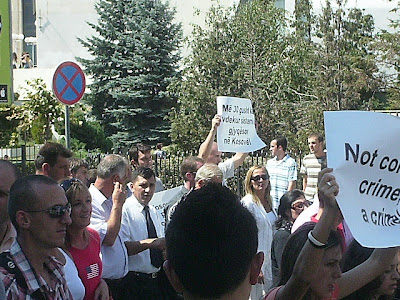


Subscribe to:
Posts (Atom)